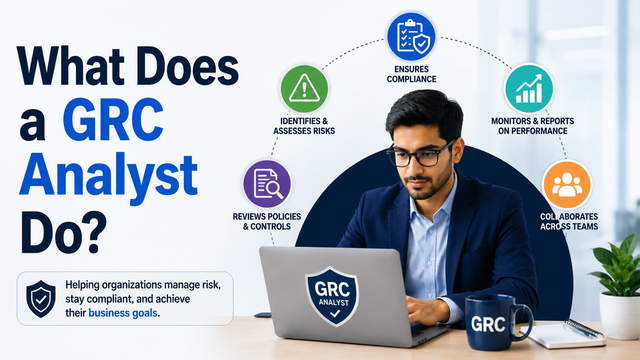
Every year, organizations face a growing list of regulations, security standards, and risk challenges. Someone has to make sense of it all, connect it to daily operations, and make sure the business stays compliant without slowing down. That person is usually the GRC analyst. If you have been researching cybersecurity careers, you have probably come across this title more than once, and for good reason. The role sits at the intersection of governance, risk, and compliance, and it has become one of the most in-demand positions in the security world.
In this article, we will break down what a GRC analyst actually does, the skills you need, the career path ahead, and why this role matters so much to modern businesses.
What Is a GRC Analyst?
A GRC analyst is a professional responsible for helping an organization manage its governance, risk, and compliance framework. In simple terms, this means making sure the company follows internal policies, meets external regulatory requirements, and identifies risks before they turn into real problems. GRC analysts are often the bridge between IT security teams, legal departments, and business leadership, translating technical risk into language that decision makers can act on.
Unlike a traditional cybersecurity analyst who focuses purely on technical threats, a GRC analyst looks at the bigger picture. They ask questions like: Are we compliant with industry standards such as ISO 27001, SOC 2, HIPAA, or GDPR? Do our security controls actually match what we report to auditors? What happens if a specific risk materializes, and are we prepared for it?
For anyone wanting a deeper technical breakdown of this role, this detailed guide on the GRC analyst role in cybersecurity covers the responsibilities, required certifications, and tools used in the profession in much greater depth.
Key Responsibilities of a GRC Analyst
The day-to-day work of a GRC analyst can vary depending on the size and industry of the organization, but most roles share a common set of responsibilities:
- Risk Assessment: Identifying, documenting, and prioritizing risks across systems, vendors, and business processes.
- Policy Development: Writing and updating security policies and procedures that align with regulatory requirements.
- Compliance Monitoring: Tracking adherence to frameworks such as NIST, ISO 27001, SOC 2, PCI DSS, and GDPR.
- Audit Support: Preparing documentation and evidence for internal and external audits.
- Vendor Risk Management: Evaluating third-party vendors for security and compliance gaps before onboarding.
- Incident Response Coordination: Working with security teams to document and report on risk events and control failures.
- Reporting: Creating dashboards and reports that communicate risk posture to leadership and stakeholders.
A GRC analyst spends a lot of time between spreadsheets, compliance software, and meetings, but the underlying goal is always the same: reduce organizational risk while keeping the business audit-ready at all times.
Skills Required to Become a GRC Analyst
Because the GRC analyst role blends technical knowledge with business communication, the skill set required is broader than a purely technical security job. Some of the most important skills include:
- A solid understanding of risk management frameworks such as NIST RMF and ISO 31000.
- Familiarity with compliance standards including SOC 2, HIPAA, PCI DSS, and GDPR.
- Strong analytical thinking to assess risk likelihood and impact.
- Excellent written communication for policy writing and audit documentation.
- Comfort working with GRC platforms such as ServiceNow GRC, Archer, or OneTrust.
- Basic understanding of IT infrastructure, cloud environments, and cybersecurity controls.
Certifications also play a big role in standing out for GRC roles. Credentials such as CRISC, CISA, CISM, and ISO 27001 Lead Implementer are highly valued by employers, especially for candidates transitioning from IT, audit, or general compliance backgrounds.
GRC Analyst Career Path and Growth
The GRC field offers a clear and rewarding career progression. Most professionals start as a junior GRC analyst or compliance analyst, gaining hands-on experience with risk registers, control testing, and audit preparation. With two to three years of experience, analysts typically move into a GRC analyst or senior GRC analyst position, taking ownership of specific frameworks or business units.
From there, career paths often branch into GRC manager, compliance manager, risk manager, or even Chief Information Security Officer (CISO) for those who want to move into strategic leadership. The demand for this career track continues to grow as regulations tighten across industries like finance, healthcare, and technology, making it one of the more future-proof paths within cybersecurity.
Salary growth in this field also tends to be steady. Entry-level GRC analysts typically start with a comfortable base salary, and compensation rises noticeably with each certification and year of experience, especially once an analyst takes ownership of a full compliance framework or leads audit relationships independently. Remote and hybrid opportunities are also common in this field, since much of the work involves documentation, reporting, and collaboration through digital tools rather than on-site technical work.
Why Organizations Need GRC Analysts
Cyberattacks are no longer the only concern for businesses. Regulatory penalties, reputational damage, and failed audits can be just as costly as a data breach. Organizations across sectors, from finance to manufacturing to logistics, now rely on GRC analysts to keep their compliance posture intact while supporting business growth. A single missed regulation or unmanaged vendor risk can result in significant fines or lost customer trust, which is exactly why this role has moved from a back-office function to a strategic necessity.
Beyond avoiding penalties, a strong GRC function also builds trust with customers and partners. Enterprise clients increasingly ask vendors to prove their security and compliance posture before signing a contract, and a well-documented GRC program can shorten sales cycles by answering those questions quickly and confidently. This is why many businesses now treat their GRC analyst as a revenue enabler rather than just a compliance checkbox.
How to Become a GRC Analyst
If you are considering this career path, here is a practical roadmap to get started:
- Build foundational knowledge in cybersecurity, IT systems, and risk concepts.
- Learn the major compliance frameworks relevant to your target industry.
- Earn a beginner-friendly certification such as CompTIA Security+ before moving to CRISC or CISA.
- Gain practical exposure through internships, entry-level compliance roles, or IT audit positions.
- Practice using GRC tools through free trials or training labs to build hands-on familiarity.
Many aspiring analysts also benefit from structured training programs and mentorship that walk through real-world case studies. Resources like Thinkcloudly’s cybersecurity career resources offer guidance for beginners looking to break into GRC, cloud security, and related fields with a clear, step-by-step approach.
Final Thoughts
The GRC analyst role has become a cornerstone of modern cybersecurity teams, offering a unique blend of technical understanding, regulatory knowledge, and business communication. As compliance requirements continue to expand across industries, the demand for skilled GRC professionals will only keep growing. Whether you are just starting your cybersecurity journey or looking to pivot from an IT or audit background, becoming a GRC analyst offers a stable, well-respected, and future-focused career path worth pursuing.
