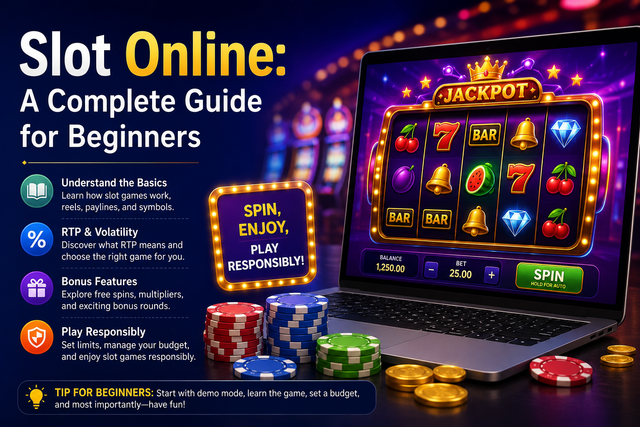
Online gaming has changed dramatically over the past two decades. What once required a visit to a physical casino can now be accessed through computers, tablets, and smartphones. Among the many forms of digital casino entertainment, slot games have become especially recognizable because they are simple to understand, visually engaging, and available in countless themes.
For a beginner, however, the variety of games, features, symbols, paylines, and terminology can initially seem confusing. Understanding how slot games operate is important before deciding whether to play. Players should know that outcomes are based on chance, that wins are never guaranteed, and that responsible limits are an essential part of the experience.
This guide explains the basics of slot online games, including how they work, the terminology beginners encounter, common game features, and practical considerations for approaching them responsibly.
What Is a Slot Online Game?
A slot online game is a digital version of the traditional slot machine. Instead of pulling a physical lever and watching mechanical reels spin, players use a website or application to start a digital spin. The screen normally displays several reels containing different symbols.
The basic objective is straightforward. After a spin, the reels stop at randomly determined positions. Certain combinations of symbols may produce a payout according to the rules and paytable of the particular game.
Modern online slots can be significantly more elaborate than traditional machines. Developers use animations, sound effects, storylines, bonus rounds, and interactive elements to make games more entertaining. Themes can range from ancient civilizations and mythology to fantasy worlds, animals, adventure, and popular culture.
Despite these differences in presentation, the fundamental idea remains based on random outcomes rather than player skill.
Understanding Reels, Rows, and Paylines
Beginners will frequently encounter three terms when exploring slots: reels, rows, and paylines.
Reels are the vertical columns containing symbols. Traditional slot machines commonly used three reels, while modern digital games frequently have five or more.
Rows indicate how many symbols are visible vertically on each reel. A typical game might have five reels and three visible rows, although developers increasingly experiment with different layouts.
Paylines determine which combinations of symbols can potentially result in payouts. Some games have a small number of fixed paylines, while others may feature dozens or hundreds of possible winning patterns.
New players should review the game’s information screen before playing because layouts and winning conditions vary considerably between titles.
How Random Number Generators Work
One of the most important concepts for beginners to understand is the random number generator, commonly called an RNG.
An RNG is software designed to continuously generate numerical sequences. When a player initiates a spin, the system uses the relevant numbers to determine where the reels will stop.
This means the outcome of one legitimate RNG-based spin is not determined by what happened during the previous spin. A game does not necessarily become “due” for a win because several previous spins resulted in losses.
This distinction matters because beginners can easily fall into the trap of searching for patterns in random results. Seeing the same symbol repeatedly or experiencing several unsuccessful spins does not reliably predict what will happen next.
Understanding randomness helps players approach slots as chance-based entertainment rather than a system that can be consistently predicted.
What Does RTP Mean?
Return to Player, usually abbreviated as RTP, is another term players are likely to see.
RTP is a theoretical percentage representing how much of the money wagered on a game may be returned to players over a very large number of plays. For example, a game displaying an RTP of 96 percent theoretically returns 96 units for every 100 units wagered over its long-term mathematical cycle.
This does not mean an individual depositing 100 units should expect to receive 96 back.
Short-term results can vary dramatically. One player might win, another might lose their entire playing balance, and another might finish close to the amount they started with.
RTP is therefore better understood as a long-term mathematical characteristic of a game, not a prediction of an individual player’s outcome.
Volatility and Why It Matters
Volatility, sometimes called variance, describes the general risk and payout pattern associated with a slot.
Games are commonly described as low, medium, or high volatility.
Low-volatility games tend to be designed around more frequent but generally smaller potential wins. High-volatility games may produce wins less frequently, while some potential payouts can be larger. Medium-volatility games usually fall somewhere between these two approaches.
Beginners should understand this distinction because volatility can influence how quickly a playing balance fluctuates.
A few factors worth checking before selecting a game include:
- Stated RTP percentage
- Low, medium, or high volatility
- Minimum and maximum bet
- Number of paylines or winning combinations
- Bonus features and their conditions
- Game rules and paytable
Reviewing these details takes only a few minutes and can make the mechanics much easier to understand.
Common Symbols Found in Online Slots
Symbols vary according to the theme of each game, but certain categories appear frequently.
Standard symbols usually provide ordinary payouts when enough matching symbols appear in qualifying positions. These might include card values, numbers, characters, objects, or images connected with the game’s theme.
Wild symbols can sometimes substitute for other standard symbols to help complete combinations. Their exact function depends on the rules of the game.
Scatter symbols often work differently from regular symbols. In some games, landing a certain number of scatters can activate free spins or another feature without requiring them to appear on a conventional payline.
Some titles also contain special bonus symbols that trigger separate rounds or interactive features.
Players should never assume that a familiar-looking symbol works identically across different games. Checking the paytable provides the most reliable explanation.
Bonus Features and Free Spins
Modern slot games often include features beyond ordinary reel spins. These elements add variety to gameplay and can change how particular rounds operate.
Free spins are among the most common features. A qualifying combination may award several spins without requiring the normal stake for each individual spin. Some games introduce additional multipliers, expanding symbols, or special reels during these rounds.
Other common features include:
- Multipliers that increase qualifying payouts
- Expanding wild symbols
- Sticky or locked symbols
- Cascading reels
- Pick-and-win bonus rounds
- Respin features
- Progressive or fixed jackpots
The presence of many features does not automatically make one game better than another. It simply changes the style and structure of gameplay.
Choosing a Suitable Game as a Beginner
The huge selection of online slots can make choosing a first game difficult. Beginners often benefit from starting with straightforward titles rather than immediately selecting games filled with complicated bonus mechanics.
Start by reading the game’s description and opening its paytable. Look at the minimum stake, volatility, paylines, symbol values, and bonus rules.
Demo modes can also be useful where legally available. A demonstration version generally allows someone to learn the interface and game mechanics without staking real money. It can be particularly helpful for understanding paylines and bonus features.
Beginners should also remember that visual design has no influence on whether a game is likely to produce a particular result. An impressive theme or sophisticated animation does not make future outcomes predictable.
Setting a Budget Before Playing
Budget management is one of the most important considerations when approaching any form of gambling.
A player should decide beforehand how much money can comfortably be spent on entertainment without affecting essential expenses. Money intended for rent, food, utilities, education, debt payments, savings, or other necessities should never become a gambling budget.
Once a predetermined limit has been reached, stopping is more sensible than increasing stakes in an attempt to recover previous losses.
Useful habits include setting both spending and time limits, keeping stakes proportionate to the available entertainment budget, and avoiding impulsive deposits.
Most importantly, losses should not be treated as money that must somehow be won back.
Avoiding Common Beginner Mistakes
New players sometimes develop assumptions about slot games that can lead to poor decisions.
One common mistake is chasing losses. After losing money, someone may increase their stake because they hope one large win will restore the balance. Since future spins remain uncertain, this can simply increase losses.
Another mistake is believing in “hot” and “cold” machines as reliable predictors. Previous results do not provide a dependable method for determining the next random outcome.
Players should also avoid choosing a game without understanding its rules. Taking a moment to review the information screen can prevent confusion about symbols, winning patterns, and bonus conditions.
Finally, gambling should not be viewed as a dependable source of income. Slot games contain a built-in mathematical advantage for the operator over the long term.
Mobile Slots and Modern Convenience
Smartphones have significantly influenced the development of online casino games. Many modern slots are designed with responsive technology, allowing their interface to adapt to different screen sizes.
Mobile accessibility provides convenience, but it also makes responsible boundaries particularly important. When games are available at almost any time, it can become easier to play longer than originally intended.
Players can reduce this risk by establishing specific entertainment periods instead of repeatedly opening games throughout the day.
Notifications can also be disabled if they encourage unnecessary play. Convenience should support entertainment rather than remove sensible personal limits.
Responsible Play Should Come First
Understanding responsible gambling is just as important as understanding reels, symbols, or paylines.
Players should participate only where online gambling is legal for them and should follow applicable age restrictions. Local laws differ considerably, so availability on the internet does not automatically mean participation is permitted in every jurisdiction.
Healthy boundaries can include:
- Setting a fixed spending limit
- Establishing a time limit
- Never borrowing money to gamble
- Avoiding play when stressed or emotionally upset
- Taking regular breaks
- Not chasing losses
- Using account limit or self-exclusion tools when needed
Anyone who feels unable to control their gambling should stop and seek appropriate professional support.
A Smarter Way to Approach Online Slots
Online slots are easy to start, but understanding their underlying mechanics makes the experience much clearer. Reels, paylines, RTP, volatility, RNG technology, bonus symbols, and free-spin features all play different roles in determining how a game is structured.
For beginners, knowledge should come before participation. Read the rules, understand that results are random, check the game’s characteristics, and establish firm financial limits before spending money.
Most importantly, slot online gaming should be approached strictly as entertainment rather than a financial strategy. There is no guaranteed technique for producing winning spins, and losses are always possible. Keeping expectations realistic and maintaining control over both time and spending provides a more informed and responsible approach to this form of digital entertainment.
