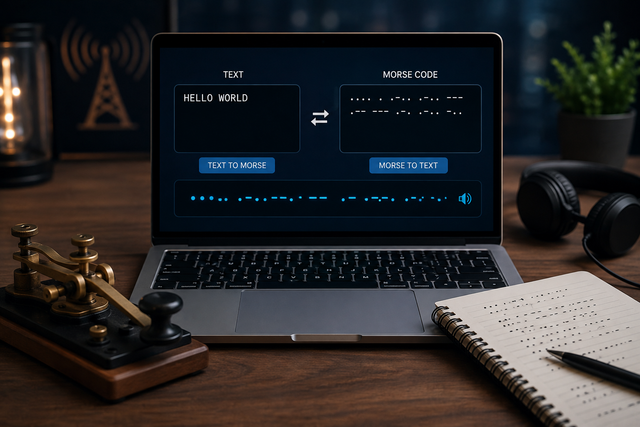
Morse code has a fascinating place in communication history. Long before smartphones, instant messaging, and email, people used combinations of dots and dashes to send information across long distances. Although Morse code is no longer a primary communication method, it remains popular among hobbyists, students, history enthusiasts, emergency communication learners, and people who simply enjoy decoding hidden messages.
A free Morse code translator makes this process much easier. Instead of memorizing every combination of dots and dashes, you can enter ordinary text and instantly convert it into Morse code. You can also reverse the process by entering Morse code and turning it back into readable text. This makes learning and experimenting with Morse code quick, convenient, and accessible to almost everyone.
What Is Morse Code?
Morse code is a communication system that represents letters, numbers, and certain punctuation marks through combinations of short and long signals. These signals are commonly represented as dots and dashes when written down.
For example, the letter A is represented as:
- –
The letter B is:
-•••
And the letter S is:
- ••
One of the most recognizable Morse code signals is SOS, represented as:
- •• — •••
Morse code was originally designed for telegraph communication. Operators could send messages using electrical pulses that traveled through wires. Over time, the system became useful in radio communication and other forms of signaling.
Its simplicity is one reason Morse code continues to attract attention today. A message can be represented through sound, light, electrical signals, or written dots and dashes.
How Does a Free Morse Code Translator Work?
A free Morse code translator automates the conversion process. Instead of manually searching through a Morse code chart, you simply enter your message into the appropriate field.
For example, if you enter:
HELLO
The translator can convert it into:
- ••• • •-•• •-•• —
If you already have a Morse code message, you can reverse the process and decode it into ordinary language.
Most online tools follow a straightforward process:
- Enter your text or Morse code.
- Select the conversion direction if necessary.
- Click the translate or convert button.
- Review the result.
- Copy the converted message for later use.
This simple approach saves time and reduces mistakes, especially when working with longer messages.
Why Use a Morse Code Translator?
Learning Morse code manually can be rewarding, but memorizing dozens of combinations takes time. A translator provides a practical shortcut while still allowing you to learn as you experiment.
There are several reasons people use these tools.
First, they are convenient. You do not need to carry a printed Morse code chart or search through reference materials whenever you encounter an unfamiliar sequence.
Second, they are fast. A short sentence can be converted almost instantly, which is particularly helpful when working with Morse code for a project or activity.
Third, they can support learning. Students can enter familiar words and compare them with their Morse equivalents. Repeating this process can gradually improve recognition skills.
Finally, free tools are accessible. You can usually use them from a computer, tablet, or smartphone without purchasing specialized equipment.
Text-to-Morse Conversion
One of the most common uses of a morse code translator is converting normal text into Morse code.
Suppose you want to convert the phrase “GOOD LUCK.” Instead of looking up every letter separately, you can enter the complete phrase and receive the corresponding sequence.
This can be useful for:
- Classroom activities
• Puzzle creation
• Secret-message games
• Scouting exercises
• Creative writing projects
• Digital artwork
• Morse code practice
Text-to-Morse conversion is also useful for people creating messages that will later be transmitted through sound or light signals.
When using a translator, spaces between letters and words are important. Different tools may use different symbols or spacing methods to distinguish individual characters and separate words.
Morse-to-Text Decoding
The reverse process is equally useful. If someone gives you a sequence of dots and dashes, you can enter it into a translator and receive readable text.
For example:
- ••• • •-•• •-•• —
can be decoded as:
HELLO
This is especially helpful when you are working with an unfamiliar message. Instead of identifying every character manually, the tool handles the conversion and gives you a quick result.
However, understanding basic Morse code still matters. If the original message contains incorrect spacing or symbols, the translator may not interpret it correctly. Knowing how Morse code is structured helps you identify and fix these problems.
Learning Morse Code With a Translator
A translator should not only be viewed as a shortcut. It can also become a useful learning tool.
Start with simple words containing letters that you recognize. Enter them into the translator and study the resulting patterns. Then cover the original text and try to decode the Morse version yourself.
You can gradually increase the difficulty by practicing:
- Individual letters
• Numbers
• Short words
• Common phrases
• Complete sentences
Another effective method is reverse practice. Write a word in Morse code without looking at the translation, then check your answer with the tool.
This combination of practice and instant feedback can make learning less frustrating.
Morse Code in Modern Communication
Although Morse code is associated with telegraphs and early radio, it has not completely disappeared. It continues to appear in educational activities, amateur radio, historical demonstrations, puzzles, and creative projects.
Some people also enjoy using Morse code as a subtle way to hide short messages. A sequence of dots and dashes may look meaningless to someone unfamiliar with the system, while someone who understands Morse can quickly recognize its purpose.
Morse code has also influenced popular culture. It frequently appears in movies, games, books, escape rooms, and online puzzles. Because it can represent language without using ordinary letters, it works particularly well for mystery and discovery-based activities.
Choosing a Good Free Translator
Not every online translator provides the same experience. When selecting a tool, look for features that make conversion simple and reliable.
A useful translator should offer:
- Clear text input
• Accurate character conversion
• Both text-to-Morse and Morse-to-text options
• Easy copying of results
• Support for numbers and common punctuation
• A clean and simple interface
• Fast results without unnecessary steps
You should also check how the tool handles spaces and unsupported characters. These details can make a significant difference when translating longer messages.
If you frequently work with Morse code, keeping a reliable translator bookmarked can save considerable time.
Common Mistakes When Translating Morse Code
Even with an online translator, users can make mistakes. The most common problem is incorrect spacing.
Morse code uses patterns for individual characters, and spaces help separate those characters. If spaces are missing or placed incorrectly, the intended message can become difficult to interpret.
Another mistake is confusing similar patterns. Some letters differ by only one dot or dash, so manually copying a long message can lead to errors.
Users should also avoid assuming that every symbol is supported by every translator. Different tools may have different levels of punctuation and special-character support.
For important messages, review the original text and converted result carefully before sharing or transmitting it.
Creative Ways to Use Morse Code
Morse code can be more than an educational exercise. It can also become part of creative projects.
You can use it to create personalized puzzles, hidden notes, digital designs, classroom games, or scavenger hunts. A short message written in dots and dashes can add an element of mystery to a birthday card or special project.
Teachers can also use Morse code to introduce students to historical communication technology. Students can translate simple words, create messages for classmates, and learn how communication systems have evolved.
Writers and game designers may use Morse code to introduce clues or secret information into stories and interactive experiences.
Make Every Dot and Dash Count
Morse code may belong to an earlier era of communication, but its basic idea remains surprisingly useful and entertaining. A free translator removes much of the difficulty involved in converting between ordinary language and dots and dashes, allowing anyone to explore the system without memorizing an entire code chart.
Whether you are decoding a mysterious message, completing a school project, creating a puzzle, or simply exploring an interesting part of communication history, a translator can provide quick and convenient results.
The best way to become familiar with Morse code is to combine technology with practice. Use a translator to check your work, learn common patterns, and gradually challenge yourself with longer messages. Before long, those seemingly random dots and dashes can start looking like a language you understand.
