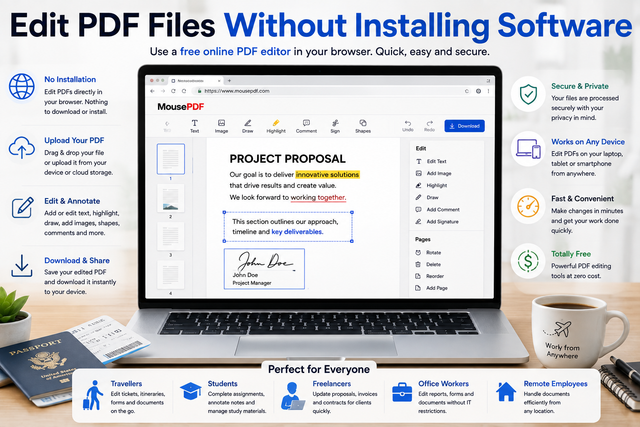
Yes, you can edit many PDF files without installing dedicated software on your computer. Browser based editing tools have made it possible to handle common document tasks directly through a web browser, which can be useful when you only need to make a quick change rather than install a full desktop application. A free online PDF editor can help users add text, annotate pages, sign forms, insert images, rearrange documents, and perform other routine tasks without requiring a traditional software installation. This approach can be particularly convenient for students, travellers, freelancers, office workers, remote employees, and people using shared computers. However, whether online editing is the right choice depends on the type of document, the complexity of the changes, privacy requirements, and the user’s access to a reliable internet connection.
How Does Online PDF Editing Work?
Traditional PDF editing software is installed directly on a computer and provides a dedicated application for opening and modifying documents. Online PDF editors take a different approach by placing the editing interface inside a web browser. Instead of downloading an application, users visit an online service, select a PDF file, and open it in the browser based editor.
The exact process varies between services, but the general workflow is straightforward. A user first selects or drags a PDF into the editor. The document then appears in an editing workspace where available tools can be selected. Depending on the platform, these tools may include text editing, image insertion, highlighting, drawing, annotations, signatures, page rotation, page deletion, page reordering, merging, splitting, and file conversion. Once the changes are complete, the edited document can usually be saved or downloaded to the user’s device.
This type of workflow can remove several steps associated with traditional software. There is no need to search for an installation file, wait for a program to install, or maintain a separate application simply for occasional PDF tasks.
Why Do People Avoid Installing PDF Software?
Installing dedicated software is not necessarily difficult, but it may be unnecessary when the required task is simple. Someone who edits a PDF only a few times a month may not want to install a large application containing dozens of advanced features they will never use.
Storage space can also be a consideration, particularly on laptops with limited capacity. Some professional PDF applications can occupy significant space and may require regular updates. An online solution can provide a lighter workflow for people who only need basic editing capabilities.
Software permissions are another issue. Students using university computers, employees working on restricted systems, or people using shared devices may not have permission to install new applications. In these situations, a browser based PDF editor can be convenient if the organisation allows access to the online service.
There is also the question of device flexibility. A person may use a desktop at work, a laptop at home, and a tablet while travelling. Browser based tools can provide a common method of accessing PDF editing functions across supported devices without requiring the same desktop program to be installed everywhere.
Editing a PDF Through a Web Browser
The process usually begins by opening a modern web browser and navigating to the selected editing platform. After choosing the PDF, the document is loaded into the editor. Users can then identify the specific function they need and make their changes.
For example, someone correcting a report may use a text tool to add information or make a minor correction. A student reviewing research material may use highlighting or annotation tools. An employee completing paperwork may add information to a form or place a signature in the appropriate area.
After editing, the document should always be reviewed before it is downloaded. PDF layouts can contain text boxes, images, tables, page numbers, signatures, and other elements that need to remain correctly positioned. A quick review can help identify misplaced text, missing pages, overlapping elements, or other formatting problems.
The final file should then be downloaded and opened independently. This confirms that the exported PDF works correctly outside the editing environment and that all changes have been preserved.
Useful for Travellers
Travellers can benefit from browser based PDF editing when they need to handle documents away from their usual computer. A person travelling for business might receive a contract that needs a signature, an itinerary that requires an update, or a form that needs additional information.
Installing software on a temporary device may not be practical, particularly if the user is working from a hotel business centre, coworking space, or another temporary location. A browser based editor can provide an alternative for simple tasks.
However, travellers should pay close attention to security. Public computers and unsecured networks may present additional risks, particularly when dealing with confidential documents. Whenever possible, sensitive files should be handled on trusted devices and secure connections.
Students Can Edit PDFs Without Installing Software
Students regularly work with PDFs for assignments, applications, course materials, research papers, and administrative forms. A student may need to complete a PDF application, add notes to study material, make a minor correction, or prepare a document for submission.
Browser based tools can be useful when a student is working from a university library or computer lab where software installation is restricted. Instead of searching for a suitable application or asking for installation permissions, the student can potentially use an online tool through the existing browser.
Online editing can also help students who move between devices. A student might start working on a laptop and later use a university desktop or tablet. Having access to a browser based PDF editor can make occasional document tasks more flexible.
Still, students should check their institution’s submission rules. Some assignments may need to be generated from the original editable document, and some organisations may have specific requirements for signatures or document formats.
Freelancers and Remote Employees
Freelancers frequently exchange documents with clients. Proposals, contracts, invoices, project briefs, and other business materials may arrive in PDF format. Often, the required change is small, such as adding a date, correcting a detail, inserting a signature, or annotating a section.
A browser based solution can be useful for these situations because freelancers may work from different locations throughout the day. They may not always have access to their primary workstation or preferred desktop application.
Remote employees face similar circumstances. Someone working from home may use a company laptop, while another employee might work from a personal device or temporary workspace. If company policies permit browser based editing, an online PDF tool can provide a convenient option for routine tasks.
However, employees should always follow their organisation’s document security policies. Confidential business documents should only be processed through services approved by the employer when such requirements exist.
Shared Computers and Temporary Devices
Shared computers are another situation where avoiding software installation can be useful. Public libraries, schools, universities, hotels, coworking spaces, and temporary offices may restrict application installations.
An online PDF editor can sometimes allow users to perform basic document tasks without changing the software configuration of the computer. This can be useful when the task is urgent and the required software is unavailable.
Users should take additional precautions when working on shared machines. They should avoid leaving sensitive documents in accessible folders, check where downloads are saved, and log out of any accounts used during the session. If the computer is not personally controlled, confidential document editing should be approached carefully.
Limitations of Online PDF Editing
Although online PDF editing is convenient, it is not suitable for every situation. Internet dependency is one obvious limitation. If the connection is unreliable or unavailable, browser based editing may be difficult or impossible.
Large PDF files can also create challenges. A document containing hundreds of pages, high resolution images, or complex graphics may take longer to load and process than a simple form. Users who regularly work with large files should check the service’s file size limitations and performance.
Advanced editing is another area where desktop software can have an advantage. Professional users may need detailed layout controls, batch processing, automation, advanced form creation, extensive security settings, document comparison, or specialised workflows. A basic online editor may not provide everything required for this type of work.
What About Sensitive PDF Documents?
Privacy should be considered before using any online service. PDFs can contain personal information, financial records, business data, contracts, legal documents, and other confidential material.
Different services use different approaches to file processing. Some may transfer documents to remote servers, while others may process files locally in the browser. Users should read the provider’s privacy information and understand how their documents are handled before choosing an online tool.
Local processing can be particularly attractive for users who do not want their documents transferred to an external server, but users should still maintain good security practices. An updated browser, secure device, strong operating system security, and careful file management remain important.
Online PDF Editor or Desktop Software?
The better option depends on what you need to accomplish. An online PDF editor can be a practical choice for occasional corrections, annotations, signatures, forms, page organisation, and other straightforward tasks. It can also be convenient for people working across multiple devices.
Desktop software may be more appropriate for professionals who work with PDFs frequently or need advanced capabilities. It can provide greater control over complex documents and may be better suited to offline workflows or specialised business requirements.
Rather than assuming that one approach is always superior, consider the actual task. If you only need to correct a sentence or sign a form, installing advanced software may be unnecessary. If you manage complex PDF workflows every day, dedicated software may offer greater efficiency.
Final Thoughts
Editing PDFs without installing software is a practical option for many everyday situations. Browser based tools can help students complete forms, travellers manage documents, freelancers update client files, and remote employees handle routine paperwork without adding another application to their devices. At the same time, users should consider internet availability, file size, document sensitivity, security requirements, and the complexity of their editing needs before choosing an online solution. If you are looking for a convenient free PDF editor for routine document tasks, MousePDF can be one option to evaluate alongside traditional desktop software and other online PDF editing solutions.
