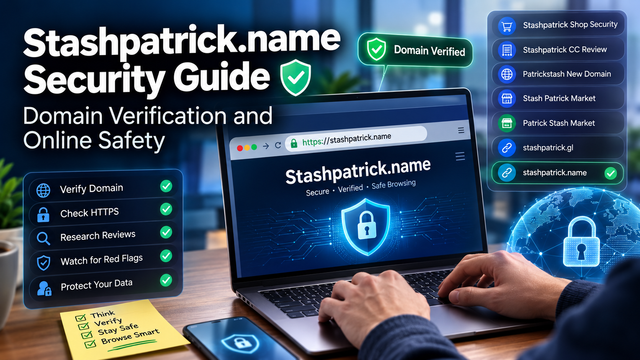
Online safety begins long before a visitor enters personal information, creates an account, or downloads a file. It starts with a basic question: is the website you are about to open actually the website you intended to visit? This question becomes particularly important when dealing with unfamiliar domains, recently changed addresses, or websites whose names appear in several variations across search results and online discussions.
People researching Stashpatrick.name may encounter related terms such as Stashpatrick Shop Security, Stashpatrick CC Review, Patrickstash New Domain, Stash Patrick Market, Patrick Stash Market, and Stashpatrick.gl. Similar names can create uncertainty because a visitor may not immediately know whether different domains belong to the same operator, represent unrelated websites, or imitate another site’s identity.
For that reason, domain verification should come before trust. Instead of assuming that a familiar-looking name means a website is legitimate, users should examine the address, technical security signals, reputation, and behavior of the site. This guide explains practical ways to approach Stashpatrick.name and similarly named domains with greater caution.
Why Domain Verification Matters
A domain name functions as a website’s digital address. Small differences in that address can lead to completely different destinations. A single changed letter, additional word, unusual extension, or misplaced character may be easy to overlook.
This is why manually checking a domain is important, particularly when the address was received through a message, forum post, advertisement, or unfamiliar referral page. Someone searching for Patrick Stash Market, for example, should not assume that every result using similar wording leads to the same destination.
Domain verification helps users identify warning signs before interacting with a website. It can reduce exposure to phishing pages, impersonation attempts, suspicious downloads, misleading payment requests, and other online risks.
A sensible verification process asks several questions. Is the domain spelled correctly? Has the address recently changed? Does the website clearly explain who operates it? Does its behavior match what visitors reasonably expect?
These simple questions can reveal more than appearance alone.
Understanding Similar Stashpatrick Domain Names
One challenge surrounding unfamiliar websites is the appearance of multiple names that look closely related. Searches involving Stashpatrick.name might also return references to Stashpatrick.gl, Patrickstash New Domain, Stash Patrick Market, or Patrick Stash Market.
Similarity alone does not establish a relationship between websites.
Domains can be registered independently, and anyone with access to a domain registrar can potentially register an available variation of a name. Consequently, users should avoid assuming that two similarly named websites share ownership simply because their branding looks alike.
When examining Stashpatrick.gl or Stashpatrick.name, check each domain independently. Look at registration information where publicly available, certificate details, historical references, reputation reports, and consistent official announcements from sources you already trust.
If a site claims that another address is its new domain, look for independent evidence supporting that claim rather than relying entirely on a notice displayed on the new website itself.
What Stashpatrick Shop Security Should Involve
Stashpatrick Shop Security is a useful search phrase for people trying to understand the safety characteristics associated with the name. However, a search phrase or online review cannot guarantee that a website is safe.
Website security involves several layers.
The first layer is connection security. Modern websites generally use HTTPS, which encrypts information traveling between the browser and website server. Most browsers display indicators showing whether the connection is protected.
HTTPS is valuable, but it should never be treated as proof of legitimacy. A deceptive website can also obtain an SSL/TLS certificate.
The second layer involves website behavior. Visitors should pay attention to unexpected redirects, browser warnings, aggressive pop-ups, automatic downloads, requests to disable security features, or unusual demands for sensitive information.
The third layer concerns identity and reputation. A trustworthy online service should provide enough consistent information for users to understand what they are dealing with.
How to Examine Stashpatrick.name Before Visiting
Before opening Stashpatrick.name or another unfamiliar domain, users can perform several basic checks without interacting deeply with the website.
Start by examining the exact spelling. Attackers sometimes use visually similar characters, extra letters, missing letters, or alternative domain extensions to create convincing copies of established websites.
Next, research the domain through reputable security and reputation services. These tools may reveal whether security systems have previously associated an address with malware, phishing, unwanted redirects, or other suspicious activity.
Useful checks include:
- Confirming the exact spelling of the domain
- Reviewing domain registration information when available
- Checking whether the site uses a valid HTTPS certificate
- Searching for independent security reports
- Looking for unexplained redirects or domain changes
- Avoiding downloads until the site’s reputation is understood
- Checking URLs carefully before entering information
No individual check provides complete certainty. The goal is to combine several signals before deciding whether further interaction is appropriate.
Evaluating a Stashpatrick CC Review
Someone searching for a Stashpatrick CC Review may find comments, reviews, forum discussions, or promotional pages making strong claims about a particular website. Such information needs to be evaluated carefully.
Not every review is independent.
Some reviews may be promotional, while others may be written without direct experience. Anonymous posts can provide useful clues, but they should not automatically be treated as verified evidence.
Look for patterns rather than relying on a single positive or negative comment. Multiple independent reports describing similar technical problems can be more informative than one unsupported claim.
The publication date also matters. Website ownership, hosting arrangements, content, and security status can change. A review written months or years ago may describe circumstances that no longer exist.
For this reason, a useful Stashpatrick CC Review should be treated as one part of a broader verification process.
Patrickstash New Domain Claims Need Careful Checking
Domain migration is normal on the internet. Businesses change domains because of branding decisions, corporate restructuring, technical issues, or changes in their online strategy.
Unfortunately, domain changes can also create opportunities for impersonation.
A search for Patrickstash New Domain may produce different addresses claiming to represent the same service. Visitors should verify such claims through established channels rather than accepting them immediately.
Pay particular attention when a supposed new domain suddenly requests credentials, financial information, cryptocurrency transfers, card information, recovery phrases, or software installations. Sensitive information should never be provided merely because a page claims to be an official replacement.
If a previous trusted source exists, check whether it independently confirms the migration. Consistent announcements across established channels provide stronger evidence than a claim appearing only on a newly registered website.
Recognizing Common Warning Signs
Suspicious websites often reveal themselves through a combination of small problems rather than one dramatic warning.
An unfamiliar domain deserves additional scrutiny when it displays several of the following characteristics:
- Frequent unexplained domain changes
- Browser certificate or security warnings
- Unexpected redirects to unrelated websites
- Pressure to act immediately
- Requests for unusually sensitive information
- Downloads that begin without clear permission
- Poorly explained payment procedures
- Inconsistent branding between pages
- Missing or questionable contact information
- Claims that cannot be independently verified
One warning sign does not automatically establish malicious intent. Several warning signs appearing together, however, should encourage users to stop and investigate before continuing.
Stash Patrick Market and Patrick Stash Market Search Results
Search engines can display many pages related to Stash Patrick Market and Patrick Stash Market. Some may provide genuine informational content, while others could exist primarily to capture search traffic.
The position of a result should not be confused with a security guarantee.
Sponsored listings, optimized pages, copied branding, and recently created websites can sometimes appear prominently. Users should therefore examine the actual destination URL before clicking.
If several pages use nearly identical names, compare them carefully. Look at domain extensions, spelling, page history, security reputation, and whether reputable independent sources recognize the address.
Avoid allowing familiarity with a name to replace verification of the actual URL.
Protecting Personal and Financial Information
Even after a website passes initial checks, users should remain careful about the information they provide.
Different types of data carry different levels of risk. An email address is not equivalent to a password, payment credential, identity document, or cryptocurrency recovery phrase.
Users should be particularly cautious when a relatively unknown website requests highly sensitive information without clearly explaining why it is necessary.
Strong password practices also matter. Never reuse an important password on an unfamiliar service. If the same password is used across multiple websites and one becomes compromised, attackers may attempt the credentials elsewhere.
Where legitimate services support it, multi-factor authentication can provide an additional layer of account protection.
Keep Your Browser and Device Secure
Website verification works best when combined with basic device security.
Browsers and operating systems should be kept updated because security patches address vulnerabilities discovered over time. Built-in browser protection can also warn users about known phishing pages, malicious downloads, or invalid certificates.
Avoid disabling browser warnings simply to access a page.
Security software can provide another useful layer, particularly when visiting unfamiliar domains. Downloads should be treated cautiously because malicious files may be disguised as ordinary documents, installers, browser extensions, or utilities.
If Stashpatrick.name, Stashpatrick.gl, or another related-looking address unexpectedly asks you to install software, reconsider whether the installation is genuinely necessary.
Why HTTPS Alone Is Not Enough
One of the most common misunderstandings about website safety concerns the padlock symbol.
HTTPS means the connection between your browser and the server is encrypted. This helps prevent third parties from easily reading information while it travels across the network.
It does not prove that the person operating the server is trustworthy.
A phishing website can have HTTPS. A fraudulent storefront can have HTTPS. A newly created imitation domain can also obtain a valid certificate.
Therefore, users should treat HTTPS as one security requirement, not a complete trust certificate. Domain reputation, identity, history, content, and behavior still need consideration.
A Safer Approach to Stashpatrick.name
The safest way to evaluate Stashpatrick.name is to avoid making assumptions based solely on its name or visual appearance. The same principle applies to Stashpatrick.gl, Stash Patrick Market, Patrick Stash Market, or any address presented as a Patrickstash New Domain.
Check the exact URL, research independent reputation signals, pay attention to browser warnings, and avoid entering sensitive information until you understand who operates the website and why the requested information is necessary.
A polished design does not establish trustworthiness, and a familiar brand name does not prove ownership. Likewise, one positive review should not replace independent verification.
Stashpatrick Shop Security and Stashpatrick CC Review searches can provide useful starting points, but visitors should compare information across reliable sources instead of depending on a single page.
Online safety is ultimately built around verification before interaction. A few minutes spent checking a domain can prevent much larger problems involving compromised accounts, unwanted downloads, exposed personal information, or financial loss. When a website’s identity remains uncertain after reasonable checks, the safer decision is simple: avoid providing sensitive information and wait until its legitimacy can be established with stronger evidence.
